The Doctor's Guide to Surviving When Modern Medicine Fails by Johnson Scott A
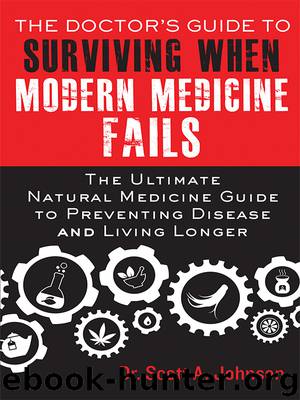
Author:Johnson, Scott A.
Language: eng
Format: epub
Publisher: Skyhorse Publishing
Published: 2015-03-11T04:00:00+00:00
REDUCE AND LEARN TO MANAGE STRESS
Stress is unavoidable, an almost daily occurrence. Everyone faces challenges and situations that have the potential to create a stress response each day. The difference is how people react to these situations. Some thrive and learn from stressful experiences, while others experience a multitude of physical and emotional effects. The American Psychological Association estimates that up to 90 percent of doctors’ office visits are stress related.543 This is an amazing and eye-opening statistic that further bolsters the unequivocal connection between all four areas of health. To achieve optimal health, stress must be reduced and managed appropriately.
Stress is defined as a state when an organism perceives the demands placed on it are greater than it can handle. A stressor is any stimulus that causes stress to an organism. The organism’s response to the stressor is the stress response. Eustress is positive stress (not all stress is bad). Eustress allows us to adapt to challenging situations and provides opportunities for growth.
Dr. Hans Selye pioneered stress research and described our response to stress, whether negative or positive, as the general adaptation syndrome (GAS). He also identified three stages of the GAS. First is the alarm stage, where the body prepares to fight or run. Stress hormones (adrenaline, noradrenaline, and cortisol) are released by the adrenal glands during the alarm stage to prepare the body for fight-or-flight. In response to elevated hormone levels, heart rate and blood pressure increase, the respiratory capacity and rate may increase, the eyes dilate, nutrient stores are released and broken down for energy, and muscle tone and performance is elevated. In addition, the body shuts down or limits certain body functions that are not considered necessary to respond to the threat, such as the immune, digestive, and reproductive systems; and all growth processes are suppressed. The resistance stage is next, where the body continues in a state of readiness, but to a lesser extent than during the alarm stage. Finally, the body reaches the exhaustion stage in which the body is no longer able to maintain the constant state of readiness.
Once a threat is neutralized the body should reverse this process and return all body systems and functions to a normal state. Conversely, if the body remains in a constantly elevated stress response the body is set up in a perfect biochemical and biological environment for disease and ill health to take place. The stress response is an innate function, the purpose of which is to enable us to protect ourselves from harm. However, our bodies can’t continue efficient function under the constant demand of stress.
Short-term (acute) stress results in the body’s immediate responses mentioned above. Long-term (chronic) stress can exacerbate or generate a plethora of health effects. Stress is involved in arrhythmia, high-blood pressure, headache, nausea, diarrhea, fatigue, heart attack, tightness in the back or neck, irritability, excess anger, anxiety, ulcer, irritable bowel disorder, decreased fertility, poor sleep, propensity to alcohol or drugs, asthma, acne, forgetfulness, substandard judgment, poor productivity, and carelessness just to name several.
Download
This site does not store any files on its server. We only index and link to content provided by other sites. Please contact the content providers to delete copyright contents if any and email us, we'll remove relevant links or contents immediately.
Inner Engineering: A Yogi's Guide to Joy by Sadhguru(6800)
The Power of Now: A Guide to Spiritual Enlightenment by Eckhart Tolle(5790)
Fear by Osho(4743)
Ikigai by Héctor García & Francesc Miralles(4279)
The Art of Happiness by The Dalai Lama(4133)
The Ultimate Bodybuilding Cookbook by Kendall Lou Schmidt(3950)
Yoga Therapy by Mark Stephens(3750)
The Little Book of Hygge by Meik Wiking(3698)
The Healing Self by Deepak Chopra(3588)
Why Buddhism is True by Robert Wright(3459)
The Hatha Yoga Pradipika (Translated) by Svatmarama(3352)
Being Aware of Being Aware by Rupert Spira(3283)
Shift into Freedom by Loch Kelly(3203)
Wild Words from Wild Women by Stephens Autumn(3157)
Work Clean by Dan Charnas(3131)
Happiness by Matthieu Ricard(3054)
More Language of Letting Go: 366 New Daily Meditations by Melody Beattie(3034)
Yoga Body & Mind Handbook by Jasmine Tarkeshi(2881)
Why I Am Not a Feminist by Jessa Crispin(2764)
